
Winterizing swimming ponds:
How biological water treatment works in winter
Early winter is a crucial phase for biologically managed swimming ponds and natural pools. While conventional pools work with chemicals, biological systems rely on natural processes. These change fundamentally as temperatures drop. If you winterize your swimming pond correctly, you create the basis for crystal-clear water in the coming spring.
This article is primarily aimed at owners of swimming ponds and natural pools. Different rules sometimes apply to fish ponds, as the needs of the animals must also be taken into account here.
At a glance: Biological water treatment largely pauses in winter, but does not stop. Nitrification bacteria reduce their activity considerably below 10 °C. Minimize the nutrient input now and prepare the technology for frost.

How biological systems change in winter
This process is highly temperature-dependent. The optimum temperature for nitrification is between 15 and 30 °C. Below 10 °C, the process slows down considerably. According to specialist literature on water treatment, the temperature should be at least 12 °C for the bacteria to work reliably. At temperatures close to freezing point, nitrification comes to a virtual standstill.
Nitrification: temperature dependence of bacterial activity
Water temperature | Bacterial activity | Source |
25-30 °C | Optimal growth | |
15-30 °C | Functional area | |
Below 10 °C | Process slowed down considerably | |
Below 12 °C | Minimum temperature not reached |
The importance of clear water
Even if biological activity decreases, water flow remains important. Stagnant water encourages rotting processes and can lead to algae problems in spring.
Experienced specialist companies such as Zinsser KG from Uelzen rely on sophisticated systems that also work in winter. As a TeichMeister specialist company, they have been working with external filter zones since 1998, in which the water circulates through planted areas and is cleaned naturally. In 2024, the company was voted into the Pool TOP 10 of the German Swimming Pool & Wellness Association with two systems.
Plants and substrates in winter operation
The aquatic plants in the regeneration zone largely stop growing. Many species withdraw or die off above ground. This is a natural process.
What is important now:
- Remove dead plant parts before they fall into the water and lead to nutrient inputs
- Leave the reed stems standing: they serve as a natural ice-free barrier and enable gas exchange
- Do not disturb substrates, as they contain overwintering microorganisms
The substrates in filter substrate areas also harbor a biofilm in winter. This reactivates more quickly in spring if it remains undisturbed.
Dealing with organic entries
Leaves, pollen and other organic materials are the biggest challenges in late fall and early winter. They bring nutrients into the system that are not completely broken down when biological activity is reduced.
Proven measures:
- Tighten leaf protection nets in good time (mesh size approx. 3 mm)
- Carry out regular surface cleaning
- Check and clean the skimmer
- Carry out soil extraction before winter
Technology in a biologically managed system: Switch off the pump or leave it running?
The question of whether the pump should run in winter is answered differently by experts. There are two basic approaches:
Option 1: Switch off the pump
At water temperatures below 8-10 °C, the filter bacteria largely stop working. In this case, the pump can be switched off.
Important when switching off:
- Drain all pipes (frost protection)
- Store the pump in a frost-free bucket of water
- Close the skimmer and nozzles
Option 2: Keep the pump running
For larger systems (from around 15,000 liters) and mild winters, reduced operation may be advisable.
Important for continued operation:
- Do not aspirate from depth (maintain 4°C layer)
- Reduce flow rate
- Check regularly
Specialized companies such as Immergrün from Hemer have over 40 years of experience in the winter management of biological systems. The company emphasizes that damage caused by frost and snow is virtually impossible with their construction methods. Many of their natural pools are even used as sauna plunge pools in winter.
Ice formation and gas exchange
A closed ice cover prevents gas exchange between the water and the atmosphere. Foul gases cannot escape and fresh oxygen cannot get into the water.
Solutions for gas exchange:
| Method | Mode of action |
|---|---|
| Ice-free holder (polystyrene) | Insulates and keeps area ice-free |
| Leave reed stems standing | Natural gas exchange through hollow stems |
| Pond aerator | Active oxygen supply in shallow water zones |
Important: Never break up ice with a hammer or axe. The resulting pressure waves can damage the fish’s swim bladder in fish ponds. Better: Place a pot of hot water on the ice and melt a hole.
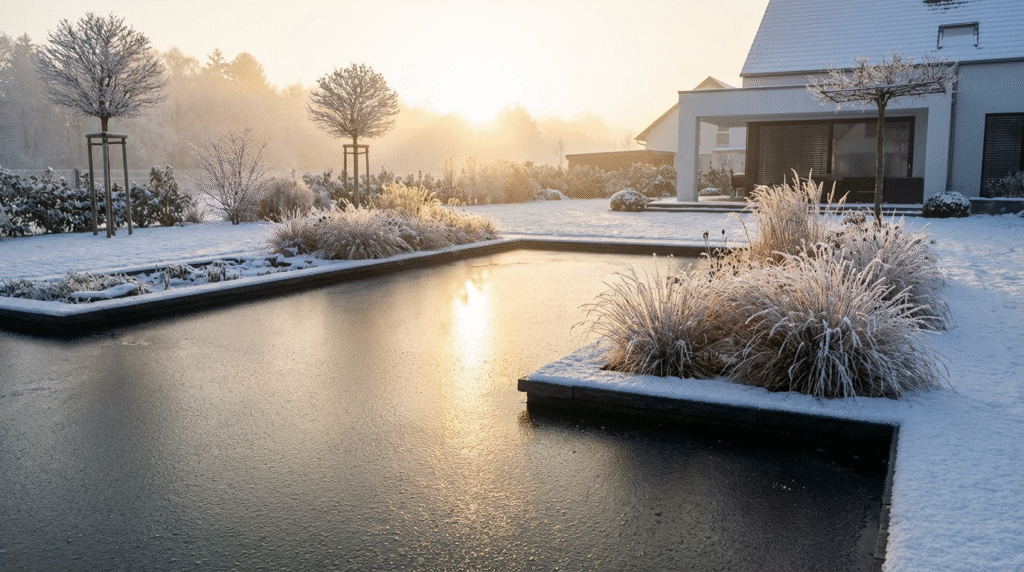
Why does it stay warmer at the bottom of the pond? The density anomaly of the water
Water has a special physical property: it reaches its highest density at 4 °C. This heavy water sinks to the bottom, while the lighter, colder water freezes on the surface.
This so-called density anomaly is the reason why ponds freeze over from above and remain about 4 °C warm at the bottom. This is vital for the survival of overwintering organisms and the biology in the substrate.
The following therefore applies: Do not suck in from the depths in winter so as not to destroy this stratification.

The winter months are also a good time for planning and minor optimizations:
- Document the current status of your system
- Plan any extensions to the regeneration zone
- Check the technology for wear
- Find out about new developments in biological water treatment
Anyone thinking about a new build or renovation will find competent advice from experienced specialist companies. Immergrün from Hemer has built over 100 swimming ponds and natural pools and offers 3D visualizations for planning. The bluegardens partner search will help you to find a qualified specialist company in your area.
Planning and optimization for spring
Biological water treatment largely pauses in winter, but it doesn’t stop. If you winterize your swimming pond correctly, you will create optimum conditions for a problem-free start to the new year.
The most important points:
- Minimize nutrient input (remove leaves, leaf protection net)
- Make technology frost-proof (drain pipes or store frost-free)
- Ensure gas exchange (ice-free holders, reeds)
- Maintain water stratification (do not draw in from the depths)
Experienced specialist companies such as Zinsser KG in Uelzen or Immergrün in Hemer know that a well-planned system will also survive the winter with ease. If you have any questions about winter maintenance or optimizing your swimming pond, the bluegardens partners will be happy to help.
Do I have to drain the water in winter?
No, the water does not have to be drained. It remains in the swimming pond and only freezes on the surface. Important: When the pump is switched off, all pipes must be drained to prevent frost damage.
Do the filter bacteria die off in winter?
No, not completely. The bacteria greatly reduce their activity at temperatures below 10 °C, but remain in the substrates. They reactivate in spring as soon as temperatures rise above 10 °C.
When should I switch off the pump?
If the water temperature is permanently below 8-10 °C, it makes sense to switch it off, as the filter bacteria then hardly work at all. For larger systems (15,000 liters or more), reduced continued operation may be advisable.
Why does it stay warmer at the bottom of the pond?
Because of the density anomaly of water: water has its greatest density at 4 °C. This heavy water sinks to the bottom, while the lighter, colder water freezes on the surface. This keeps the bottom of the pond at around 4 °C.
Can I open the ice sheet?
No, never use a hammer or axe. The pressure waves can damage the fish’s swim bladder in fish ponds. Melt a hole with hot water instead.
When should I start again in spring?
As soon as the water temperature permanently rises above 10 °C, you can put the technology back into operation. Biological activity will then slowly resume.